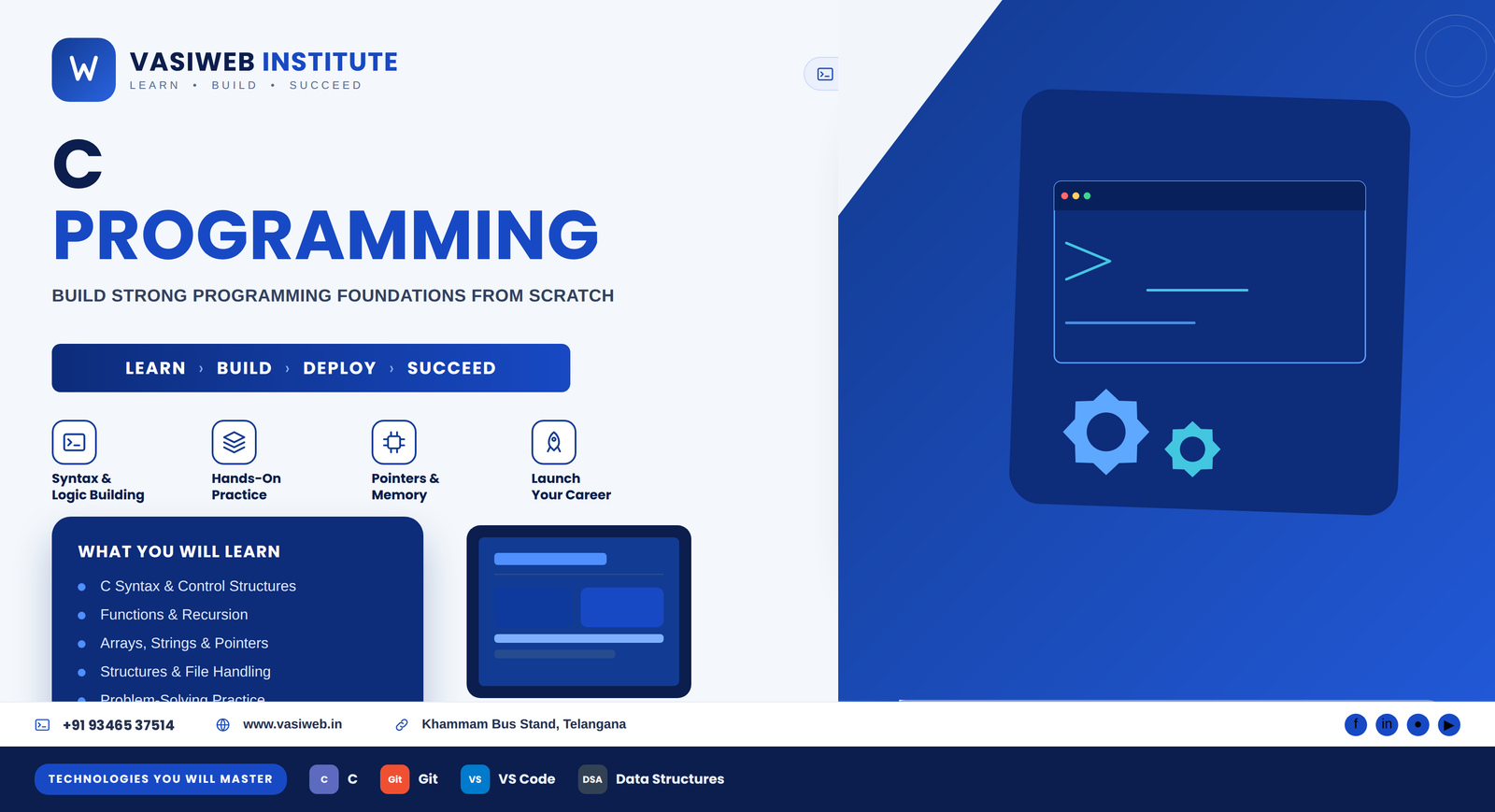
About C Language at Vasi Web
C Language is the foundation of modern programming. This course builds strong logical thinking through daily coding exercises — variables, loops, functions, arrays, strings and pointers. Recommended for intermediate students, engineering first-years and anyone planning to learn C++, Java or embedded systems later.
Who Should Join C Language?
What You Will Learn in C Language
- C program structure and compilation process
- Conditional statements and all loop types
- Arrays, strings and multi-dimensional arrays
- Functions, call by value/reference
- Pointers, structures and file handling intro
C Language Syllabus
C Basics
- Compiler & IDE setup
- Variables & data types
- Operators
- printf/scanf
Control Structures
- If-else & switch
- for, while, do-while loops
- Break & continue
- Logic building
Arrays & Functions
- 1D & 2D arrays
- String handling
- Functions
- Recursion intro
Pointers & Structures
- Pointer basics
- Pointer & arrays
- Structures
- Typedef
Files & Programs
- File open/read/write
- Mini projects
- Pattern programs
- Exam-style problems
Tools & Software Covered
- GCC / Turbo C compiler
- Code::Blocks / VS Code
- stdio.h library
- Pointer & memory exercises
Career Opportunities After C Language
- Programming foundation for IT jobs
- Embedded systems trainee (with further study)
- Competitive coding preparation
- Software developer path via C++/Java
Frequently Asked Questions
Why learn C in 2026?
C teaches memory, logic and system-level thinking — essential for C++, Java, OS and embedded programming.
Is C suitable for 10th pass students?
Yes, if you have basic maths/logic interest. Many students start C after DCA or alongside degree studies.
Can I join C++ directly without C?
We recommend C first for strong fundamentals, but C++ course includes a quick revision of basics.